Mold Removal Homeland, CA
We're the Perris-based mold team your Homeland neighbors call when the musty smell won't quit. Free inspection, honest testing guidance, and containment-based remediation per the S520 standard — about nine miles east-southeast of home base, straight down Highway 74.
- Free on-site inspection
- 9 miles from Perris — fast response
- S520 containment process
- Written clearance report
The Mold Problems We See in Homeland Homes
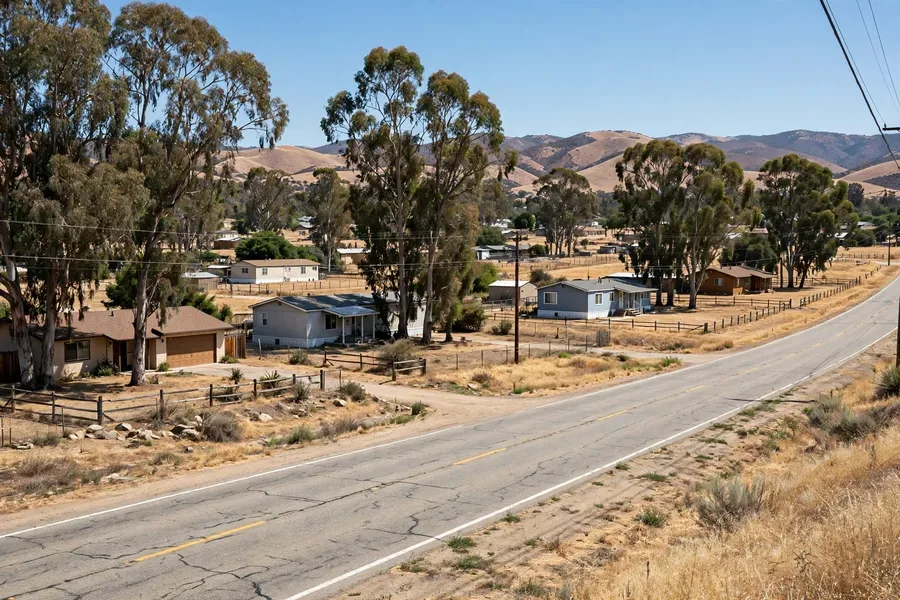
Homeland sits about nine miles east-southeast of our shop in Perris, down Highway 74 toward Hemet, and it doesn't look like anywhere else we serve — because the housing doesn't follow a tract script. This is an unincorporated Riverside County community of about 6,800 people spread over 4.3 square miles: ranch houses on large lots, older manufactured homes on permanent foundations, mobile homes going back to the 1960s, and newer infill mixed in. No HOA standards, no city storm-drain system, and properties that have been added onto, patched, and re-roofed on the owner's timeline for decades.
Here's what that means in practice. A 1978 double-wide on a permanent foundation off Homeland Avenue has a belly-wrap moisture trap underneath that nobody has looked at since the Reagan administration. A ranch house on an acre east of town has an outbuilding, a shop, and a leach field — and nobody knows which one is feeding the musty smell in the hallway. And along the Highway 74 corridor, older commercial-residential mix buildings get repurposed over and over, each remodel sealing old moisture problems behind new drywall.
We're Perris Mold Pros, based at 580 Coliseum St in Perris — close enough that a mold removal Homeland call gets a same-day or next-day inspection in most cases. We don't do scare tactics and we don't sell testing you don't need. If you can see the mold and it's a small, contained patch, we'll tell you that too.
Homeland Areas & What They Mean for Mold
Homeland never had a big master plan, so the housing tells its story street by street — and where you live changes what we look for. Every mold removal Homeland job starts with understanding the street, not a script.
The Highway 74 corridor
State Route 74 runs right through Homeland on its way from Perris to Hemet, and the corridor is a strip of mixed-use buildings, small commercial spaces, and homes fronting the highway. These are the hardest-working structures in town: decades of remodels, flat or low-slope roof additions, and parking-lot runoff sheeting against foundations during storms. We see wall-cavity mold behind layers of old remodels here — where the third remodel sealed in the moisture problems the first two left behind. On inspections along 74, we spend extra time on roof transitions and anywhere an addition meets the original structure.
The old core around Homeland Avenue
The streets around Homeland Avenue hold the town's oldest site-built homes — small ranch houses from the 60s through the 80s, many expanded or enclosed over the years. This is classic deferred-maintenance territory: original plumbing runs, aging roof valleys, and enclosed patios that were never detailed for waterproofing. The mold pattern here is slow and quiet — a pinhole supply-line leak or a failed shower pan that soaks framing for a year before a baseboard swells. Moisture-meter work inside walls around wet rooms is non-negotiable on these properties.
Manufactured-home communities, including Highland Palms
Manufactured and mobile homes are a defining feature of Homeland — the county mobile-home registry lists Highland Palms Senior Estates right here in town (30777 Butia Palm Ave), a 55+ community with over 500 spaces established in 1972. Manufactured housing has its own mold physics: thin wall systems with minimal cavity depth, particle-board subflooring that swells and grows mold fast when wet, and the belly wrap underneath that traps moisture rising from the soil. Roof-over seams and aging window flashing are the two failure points we see most. The good news: these homes are usually straightforward to contain and remediate because the construction is accessible. The bad news: once particle board swells, it doesn't get un-swollen — affected sections come out.
Ranch properties on acreage
East and south of the town core, Homeland goes rural — ranch houses on large lots with shops, sheds, and outbuildings, some parcels still on septic. This is where mold gets complicated: a failing leach field feeds moisture under a home invisibly, grading around an acre lot pushes storm runoff toward (not away from) the foundation, and an unconditioned shop or guest unit attached to the house shares air and framing with the living space. We treat these properties as a system, not a single structure — the moisture source is often twenty yards from where the mold shows up.
Water, Drainage & Flood Exposure in Homeland
Homeland's retail drinking water comes from Eastern Municipal Water District (EMWD) — the same district that serves Perris — and EMWD provides sewer service across much of the community. But "unincorporated" is the word that shapes everything else about water here. There is no city public-works department grading your street, no municipal storm-drain system under the curb, and drainage is largely whatever the county roads and your neighbors' grading make of it. In a heavy winter storm, water sheets across rural lots and dirt access roads in ways that would never happen on a curbed tract street.
The geography adds its own exposure. Homeland sits in the San Jacinto Valley between the Lakeview Mountains to the northwest and the Diamond Valley — home to Diamond Valley Lake, the Metropolitan Water District's 800,000 acre-foot reservoir a few miles south. The county's general plan flags 100-year floodplain and dam-inundation hazards along the San Jacinto River corridor that crosses the valley. You don't need to be in a mapped flood zone to get hurt by water here: a winter atmospheric river or a summer monsoon burst running off those hillsides can pond against a slab or crawl-space footing for days.
And then there's the everyday water story, which causes more mold than floods ever will. Older supply lines and water heaters on rural lots fail at the same rate as anywhere else — but out here, a leaking water heater in a garage no one walks through, or a supply line feeding a distant outbuilding, can run for weeks before anyone notices. On acreage, we always ask about outbuildings, hose bibs, and irrigation lines, because the plumbing footprint is three times what a tract home has.
How Much Does Mold Remediation Cost in Homeland, CA?
Homeland pricing tracks the Southern California published ranges — the job costs what the scope costs, not what the ZIP code is. Here are the ranges we see quoted across the industry, so you can sanity-check any mold remediation Homeland estimate, including ours:
| Scope | Published range (SoCal) | Homeland note |
|---|---|---|
| Inspection | $250 – $1,170 | Ours is free — the inspection, not the lab work if testing is warranted |
| Remediation, per square foot | $10 – $30 / sq ft | Manufactured-home jobs often trend lower (accessible construction); acreage multi-structure jobs higher |
| Small jobs (under ~50 sq ft) | $600 – $2,500 | Single bathroom or bedroom wall — the most common call we get |
| Typical whole job | $1,500 – $7,100 (mid ~$2,800) | Most Homeland single-structure jobs land in this band |
| HVAC / ductwork | $1,500 – $10,880 | Full system decon isn't cheap — get it in writing |
| Whole-house remediation | $10,880 – $32,640 | Rare; usually flood or long-neglected leak scenarios |
Ranges compiled from Angi, legalclarity.org, restoreadvisor.com, and funguyinspections.com (October 2026). Published ranges, not quotes — every home is different.
Our rule, stated plainly: anyone who quotes you a firm price over the phone without seeing the job is guessing. We price from an in-person inspection, in writing, before work starts. And a word on insurance: California homeowners policies typically cap mold coverage at a $5,000–$10,000 sublimit, and only for sudden events like burst pipes — slow leaks are usually excluded. We'll document everything so your claim has its best shot.
Where We Find Mold in Homeland Homes
Same valley, different housing — and when we do mold removal in Homeland, this is our greatest-hits list:
Manufactured-home underbellies and subfloors
The belly wrap under a manufactured home is supposed to keep moisture out, but when it tears or sags, ground moisture rises straight into the floor system — and the particle-board subfloor above it is mold's favorite food. We find subfloor mold in older manufactured homes constantly, usually discovered during a flooring replacement or when a soft spot appears underfoot. If your manufactured home's floors feel spongy in spots, get a mold inspection before the new flooring goes down.
Roof-over seams and aging window flashing
Older manufactured homes often have metal roof-overs and original window flashing, both of which fail at seams and edges. Water tracks in silently and feeds the thin wall cavities, where there's almost no depth for it to dry. Ceiling stains along roof-over seams and discoloration around window corners are the telltales we look for first.
Enclosed patios and owner-built additions
Homeland's unincorporated character means generations of owner-built additions — enclosed patios, room additions, converted garages. Many were built without proper flashing, vapor barriers, or ventilation, so they trap moisture by design. The seam where the addition meets the original house is the number-one mold spot on these properties.
Slab edges and low-lying rooms
Without curbs and gutters, stormwater ponds against slabs. Irrigation soaking the soil against the foundation does the rest. The first sign is usually discolored baseboards or a musty smell at floor level — especially in rooms that sit at the low end of the lot's grade.
HVAC closets and ductwork
Older air handlers with rusted drip pans and coils that haven't been cleaned in a decade are common in the older stock here. When the system runs, it distributes spores house-wide — which is why a "mystery" musty smell that worsens when the AC kicks on points at the ducts. See HVAC and duct mold remediation.
Outbuildings, shops, and guest units
On acreage, the shop or guest unit is often unconditioned, poorly ventilated, and plumbed — a perfect mold habitat that shares framing and sometimes air with the main house. We check every structure with plumbing or enclosed space on rural properties, not just the one you sleep in.
Our 6-Step Mold Process in Homeland
Six steps, same standard every time — the ANSI/IICRC S520 process, adapted to what a mold remediation Homeland job actually needs:
Assess
We walk your Homeland property room by room — ranch-house attics, wall cavities, manufactured-home underbellies, slab edges, HVAC — and trace every moisture source with meters before anything gets opened up.
Test
When the situation calls for it, air and surface samples go to an independent accredited lab. No in-house lab, no conflict of interest.
Contain
The work area gets sealed under negative air pressure so spores can't migrate into the clean parts of your home while we work.
Remove
Contaminated materials come out; salvageable surfaces get HEPA-vacuumed and treated with EPA-registered antimicrobials.
Scrub
Industrial HEPA air scrubbers run 24 to 48 hours to pull remaining airborne spores out of the space.
Confirm
A final clearance check verifies the job. You get a written report documenting what was found, what was done, and that it's clean.
One thing Homeland homeowners ask about: do you handle manufactured and mobile homes? Yes — all the time. The S520 process works the same; the construction just means we spend more time on subfloors, underbellies, and wall systems, and we're upfront when a section of swollen particle board has to come out rather than be "treated." If you own a rental or multi-unit property here, our commercial mold remediation process includes the documentation trail California habitability disputes require.
Related Mold Services
Mold Inspection & Testing
Visual inspection, moisture mapping, and lab-backed sampling — only when it's actually needed.
Mold Inspection & Testing in Perris, CAMold Remediation
Full containment-based removal per the ANSI/IICRC S520 standard. Our flagship service.
Mold Remediation in Perris, CABlack Mold Removal
Stachybotrys and other problem molds, handled with CDC-accurate facts — no scare tactics.
Black Mold Removal in Perris, CAFAQs — Homeland, CA
Straight answers, no scare tactics.
We're based in Perris, about nine miles west on Highway 74 — most Homeland inspections happen same-day or next-day. Emergency calls are 24/7 at (951) 484-2620.
The on-site inspection and written findings are free. If lab testing is warranted — hidden mold, a real-estate transaction, an insurance claim — we'll tell you exactly what the lab charges before anything is sampled. No upsells.
Yes — manufactured and mobile homes are a big part of what we see in Homeland. The S520 containment process is the same; the construction just changes the details. We'll tell you honestly when swollen particle board or damaged belly wrap needs to come out instead of being cleaned.
Being unincorporated doesn't cause mold, but the conditions that come with it do: no city storm-drain system, rural lots where grading pushes water toward foundations, older housing with decades of owner-built additions, and properties where a leak can run unnoticed. Those are exactly the scenarios our inspections are built for.
Nothing directly — EMWD is your water utility, not a mold cause. It matters because knowing your infrastructure helps us trace problems: on acreage we ask about irrigation lines, hose bibs, and outbuildings tied to the same supply, and outlying rural parcels on septic need the leach field considered as a moisture source.
Sometimes. California policies typically include a $5,000–$10,000 mold sublimit that applies to sudden events like burst pipes — slow leaks and maintenance issues are usually excluded. We document everything to give your claim its best shot, but we can't promise coverage.
For small, contained jobs, usually yes — containment keeps the work area sealed off. For larger jobs or Stachybotrys (black mold), we may recommend being out 24–48 hours, especially with kids, seniors, or respiratory conditions in the home.
In practice, reputable companies mean the same work by either name: find the moisture, contain the area, remove the contamination, fix the source, verify it's clean. Our full explainer is on the mold remediation vs. mold removal page.
Then you may not need us at all — small surface mold on tile and grout often responds to proper cleaning and fixing the ventilation. We'll tell you that honestly on a call. If it's in the drywall or keeps coming back, that's when an inspection earns its keep.
Most Homeland single-structure jobs run 1–3 days including containment, removal, and air scrubbing. Multi-structure jobs on acreage can run 3–5 days. Clearance verification adds a day for lab turnaround when it's warranted.
Smell Something Musty in Homeland?
Don't wait for a small patch to become a wall cavity. A free inspection tells you exactly what you're dealing with — and what you're not.
- Perris-based — 580 Coliseum St, Perris, CA
- Containment-based process per the S520 standard
- Honest testing guidance — no upsells
Request a Free Quote
Tell us what you're seeing — we'll get back to you shortly.